Key Facts
Height - 5,895m (19,341 ft) — Africa's highest point, world's tallest free-standing mountain
No Technical Skill Required — no ropes, no ice axes, no climbing experience
Realistic Cost $1,800–$6,500 depending on route, days, and operator
Recommended Duration 7–8 days minimum for safe acclimatization
Success Rate 65–95% depending on route length and operator quality
Best Seasons January–March and June–October
Minimum Age 12–16 depending on operator; under-10s barred above 3,700m
Solo Climbing Not permitted — licensed guide required by law since 1991
Every year, roughly 35,000 people attempt Kilimanjaro. Most of them are not mountaineers. They are teachers, accountants, retirees, first-time trekkers who decided one day that they wanted to stand on the roof of a continent.
That's the part about Kilimanjaro that surprises people most. It requires no technical skill whatsoever. No ropes. No ice axes. No prior climbing experience. What it requires instead is something that sounds simpler and turns out to be harder: patience, at an altitude where your body wants to do everything except walk slowly.
Here is everything you need to actually plan this properly.
Why Kilimanjaro Is Different From Every Other Big Mountain
Kilimanjaro is a dormant volcano rising alone from the Tanzanian plains rather than sitting within a mountain range — which is part of why the ascent feels so dramatic. You start in tropical heat and finish in arctic cold, crossing five distinct ecological zones in under a week: rainforest, moorland, alpine desert, and finally the glaciated summit zone.
The technical difficulty is genuinely low. Some sections, like the Barranco Wall on the Machame route, involve scrambling over rock that looks intimidating in photos but requires no equipment beyond hands, feet, and a guide who knows the route.
The real difficulty is altitude. At 5,895 metres, the air contains roughly half the oxygen available at sea level. Altitude, not fitness, is what actually determines whether you reach the summit.
The Real Cost — What You're Actually Paying For
Prices vary enormously across operators, and understanding why matters more than just finding the cheapest number.
Budget climbs (5–6 days): $1,800–2,700
Mid-range climbs (7 days): $2,200–3,600
Premium 7-8 day expeditions: $3,000–5,000
Luxury and private climbs: $5,000–6,500+
Park fees alone make up 35–70% of your total cost. Kilimanjaro National Park charges a daily entry fee, camping fees per night, rescue fees, and forest fees for the lower slopes — all collected by the Tanzania National Parks Authority and built into your operator's package price. You won't handle these directly; a licensed operator manages every permit on your behalf, since independent climbing has been prohibited since 1991.
What separates a $1,800 climb from a $4,000 climb isn't luxury. It's safety margin. Cheaper packages often mean shorter routes with less acclimatization time, smaller support teams, and less experienced guides. Budget 5-day itineraries can have summit success rates as low as 50%, while well-run 7-8 day expeditions on the same mountain reach 85-95%.
The mountain doesn't care how much you paid. Your acclimatization schedule does.
Search and compare Kilimanjaro climbing packages →
The Routes — Which One Is Actually Right for You
Seven established routes reach the summit. Here's the honest breakdown.
Machame Route — "The Whiskey Route"
The most popular route on the mountain, known for its scenic diversity and solid acclimatization profile. Takes 6-7 days. Camping throughout. Good balance of beauty, challenge, and success rate for most first-time climbers.
Lemosho Route
Widely considered the most beautiful route and one of the safest, thanks to a longer itinerary and gradual acclimatization profile. Takes 7-9 days. Starts on the quieter western side of the mountain before joining the Machame route higher up. If budget allows, this is often the best all-round choice.
Rongai Route
The only route approaching from the north, near the Kenyan border. Less scenic than Machame or Lemosho but significantly quieter, and it stays dry during the rainy season when southern routes get hammered by rain. A strong choice for climbers who specifically want solitude over spectacle.
Marangu Route — "The Coca-Cola Route"
The oldest route and the only one offering hut accommodation instead of camping. Takes 5-6 days. Often chosen by first-time trekkers for the perceived comfort, but the shorter standard itinerary means a lower acclimatization profile and correspondingly lower summit success rate unless extended.
Umbwe Route
The steepest, most direct, most physically demanding route on the mountain. Rapid elevation gain with minimal acclimatization built in. Not recommended for first-time high-altitude trekkers — this is a route for climbers who've done Kilimanjaro before or come from serious mountaineering backgrounds.
Northern Circuit
Kilimanjaro's longest route at 8-9 days, circling the mountain through its remote northern slopes. Delivers the highest success rates on the entire mountain — 90-95% — through the most gradual acclimatization profile available. If time and budget allow, this is statistically your safest option.
Shira Route
Similar to Lemosho but with a faster initial ascent via vehicle to the Shira Plateau, reducing early acclimatization time. Less commonly recommended for that reason.
Success Rates — The Honest Numbers
The overall estimated summit success rate across all routes and operators sits around 65%, but that number is misleading on its own. Budget 5-6 day routes can have success rates as low as 50%, while well-planned 7-9 day itineraries on routes like Lemosho and the Northern Circuit reach 85-95%.
The pattern is consistent across every serious operator's data: days on the mountain matter more than fitness level. A moderately fit person on an 8-day route has a significantly better chance of summiting than an elite athlete rushed through a 5-day itinerary.
This is the single most important piece of advice in this entire guide: do not choose your route based on price alone. The cheapest 5-day package is, statistically, the version of this trip most likely to end in disappointment partway up the mountain.
Training — What Actually Prepares You
You do not need to be an athlete. You need cardiovascular endurance and the mental discipline to walk slowly when every instinct tells you to walk faster.
3-6 months out: Build a baseline through regular hiking, running, or cycling 3-4 times weekly, gradually increasing distance and elevation gain.
2-4 months out: Intensify with longer hikes of 4-6 hours, carrying a weighted daypack of 15-20 pounds, ideally on genuinely hilly or uneven terrain. Back-to-back training days on consecutive weekends help simulate the cumulative fatigue of a multi-day trek.
Final weeks: Taper rather than push harder. Break in your boots completely — there is no faster way to end a Kilimanjaro attempt early than blisters on day two. Test every piece of gear on an actual training hike before the mountain, not for the first time on the trail.
Baseline fitness target: comfortable hiking 4-6 hours with a daypack on inclined terrain, and general daily walking or stair-climbing capacity.
The mental preparation matters just as much. The Swahili phrase you'll hear constantly from your guides is pole pole — slowly, slowly. Climbers who fight this instruction, who push pace to prove fitness, are disproportionately represented among those who don't summit. The mountain rewards patience over strength.
Altitude Sickness — What You Need to Actually Know
Acute Mountain Sickness is the real obstacle on Kilimanjaro, not your legs.
Symptoms include headache, nausea, dizziness, fatigue, and loss of appetite — mild versions are extremely common and manageable with proper pacing. Severe forms, HAPE (High Altitude Pulmonary Edema) and HACE (High Altitude Cerebral Edema), are genuinely life-threatening and are the reason a good guide's judgement matters more than almost anything else on this mountain.
What reduces your risk:
- Choosing a 7+ day route over a shorter one — acclimatization time is the single biggest factor
- The "climb high, sleep low" principle — some itineraries build in acclimatization hikes to a higher point before descending to sleep at a lower camp
- Drinking 3-4 litres of water daily on the mountain
- Reporting any symptoms to your guide immediately rather than pushing through silently — experienced guides can detect early altitude symptoms before they become dangerous
- Discussing altitude sickness medication such as Diamox with a travel medicine doctor before departure
Every reputable operator conducts daily health checks — pulse oximeter readings, symptom questionnaires — throughout the climb. If a guide tells you to descend, that instruction is not up for negotiation. It has likely saved more lives on this mountain than any single piece of equipment.
What a Typical Day Actually Looks Like
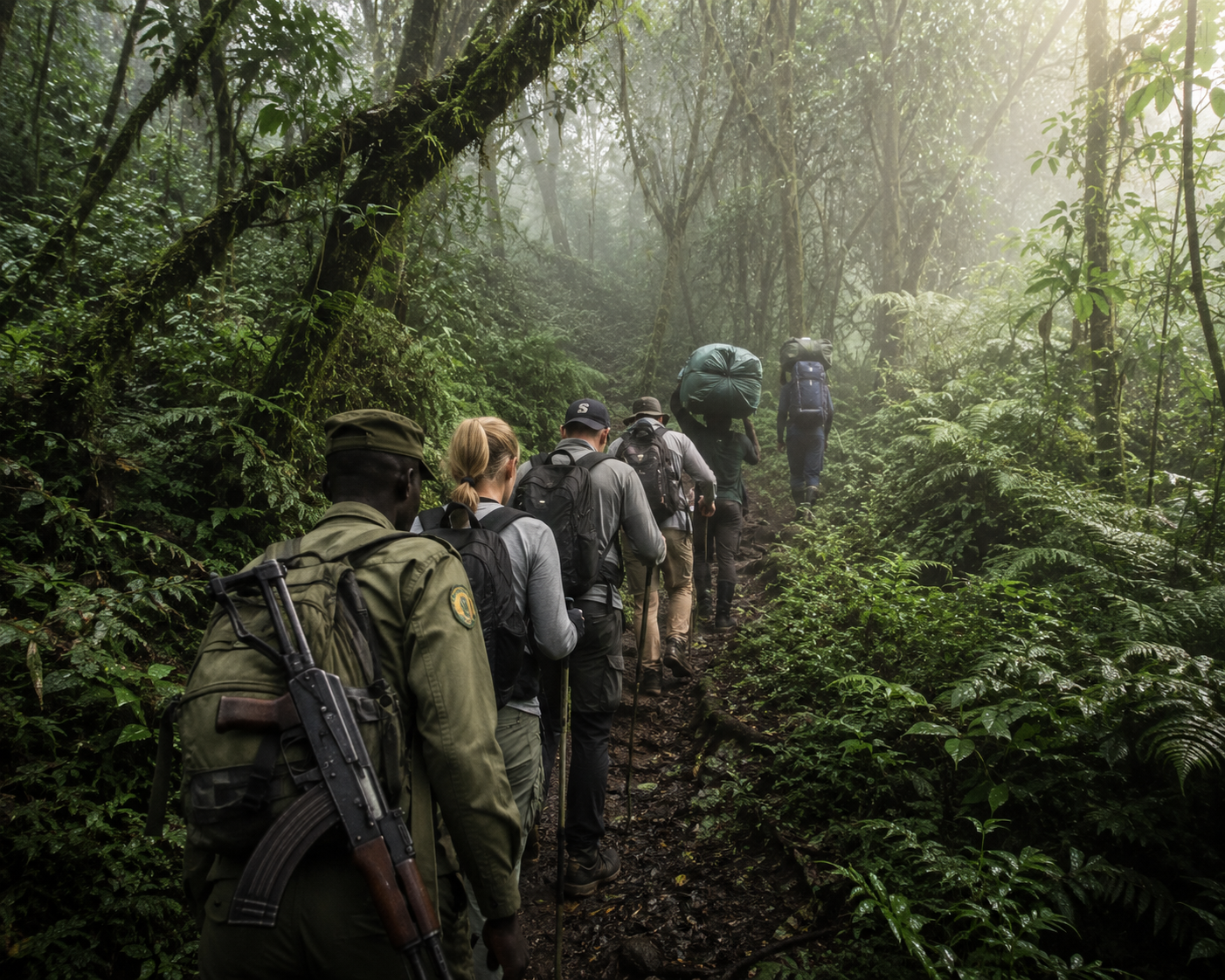
Wake before dawn to porters already breaking down camp around you. A hearty breakfast — you'll need the calories more than you expect. Then several hours of trekking at a deliberately unhurried pace, guides setting a rhythm that will feel almost frustratingly slow for the first two days and will make complete sense by day four.
Porters — carrying the bulk of the group's equipment — move ahead of the main group and have camp largely set up by the time trekkers arrive. This isn't luxury; it's how the logistics of a week on an unsupplied mountain function at all. Tipping porters properly at the end of the trip is both custom and, frankly, morally necessary — they carry the heaviest loads for the lowest pay on the mountain.
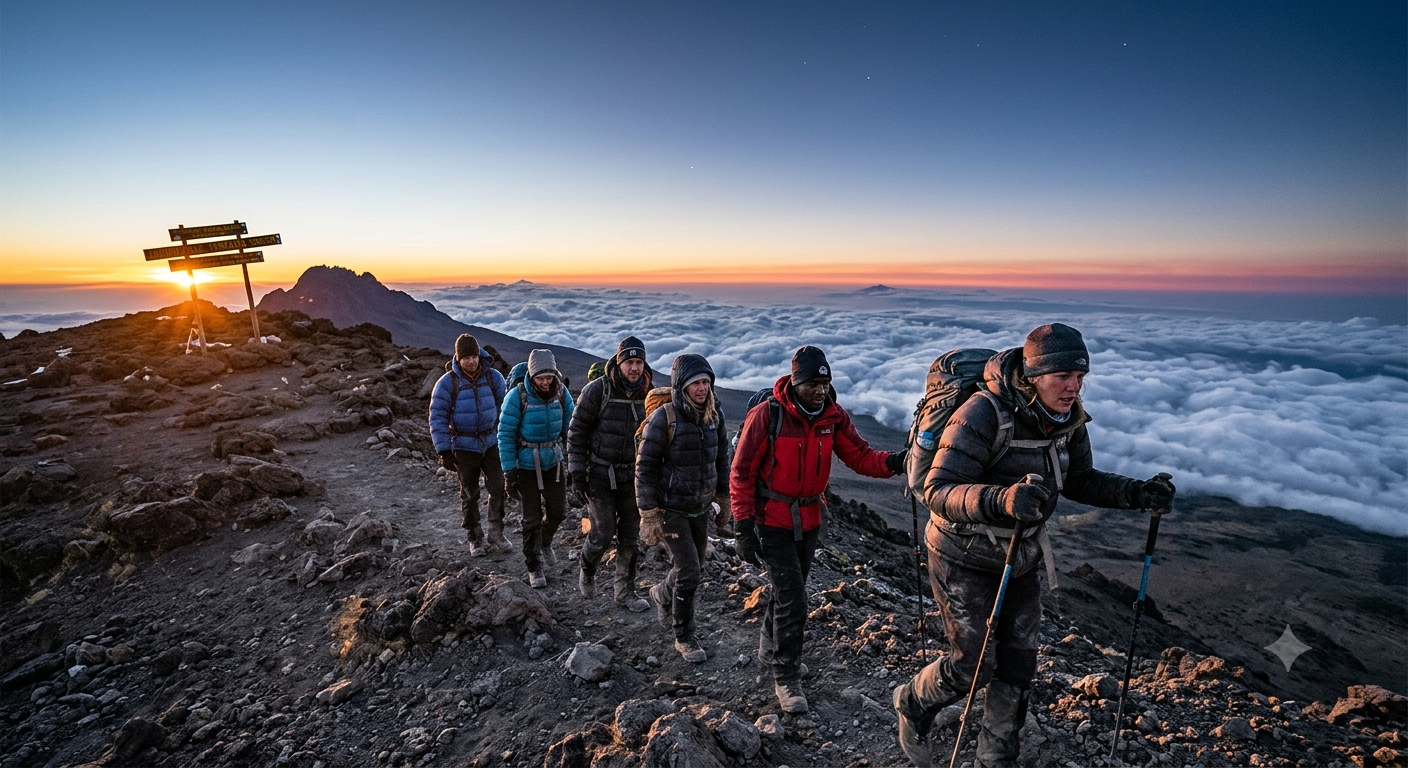
Summit night is where everything changes. Climbers typically leave camp around midnight, climbing through darkness in freezing temperatures to reach Uhuru Peak around sunrise — a push that can take 6-8 hours of climbing on top of everything already completed that week. This single night pushes total trekking time to 12-14 hours including the descent back to a lower camp for rest.
It is, by every account from people who've done it, the hardest and most memorable single night of the entire experience.
When to Go
Prime dry seasons: January-March and June-October offer the most stable weather and clearest summit conditions.
The shoulder consideration: April-May and November bring Tanzania's rains, which can make southern routes like Machame and Lemosho considerably harder going. The Rongai route on the mountain's northern side stays comparatively dry during this period and is worth specifically considering if these are your only available months.
Temperature range: Roughly 27°C (80°F) at the base rising through the rainforest, dropping to as low as -23°C (-10°F) at the summit. Layering is not optional.
Packing — The Non-Negotiables
- Waterproof, broken-in hiking boots — never new boots on this mountain
- Layered clothing system — base layers, insulating layers, waterproof outer shell
- Down jacket rated for genuinely sub-zero temperatures for summit night
- Warm hat, gloves, and a second pair for summit night specifically
- Sleeping bag rated to at least -15°C, even on routes with hut accommodation
- Trekking poles — genuinely useful on the steep, loose sections
- Headlamp with spare batteries — essential for the midnight summit push
- Sunscreen and sunglasses — the equatorial sun at altitude is brutal
- Water purification tablets or a filter, as backup to porter-carried water
- Diamox or altitude medication, discussed with a doctor beforehand
- Cash for tips — organised and given to the full team on the final morning, per local custom
What Nobody Tells You
The summit night is genuinely brutal, and that's normal. Nobody arrives at Uhuru Peak feeling fresh. Exhaustion, cold, and altitude combine into an experience that most climbers describe as the hardest thing they've physically done. This is not a sign anything went wrong.
You will not shower for a week. Baby wipes become your best friend. Nobody on the mountain cares.
The toilet situation varies by route and operator quality. Some operators carry private portable toilet tents; others rely entirely on shared long-drop facilities at camps. If this matters to you, ask specifically before booking.
Your operator's quality matters more than almost anything else on this list. Look specifically for membership in organisations like the Kilimanjaro Porters Assistance Project, which verifies ethical treatment and fair pay for porters. Operators that cut costs on staff welfare often cut corners on client safety too.
Digital permits are standard now, but bring printed backups. Network coverage on the mountain is unreliable, and a printed permit avoids unnecessary complications at ranger checkpoints.
Children under 10 are barred from ascending above 3,700 metres by park regulation, regardless of operator or fitness level.
Combining Kilimanjaro With the Rest of Tanzania
Kilimanjaro sits close enough to Tanzania's other major draws that combining them into one extended trip makes enormous sense — and most experienced travellers do exactly that.
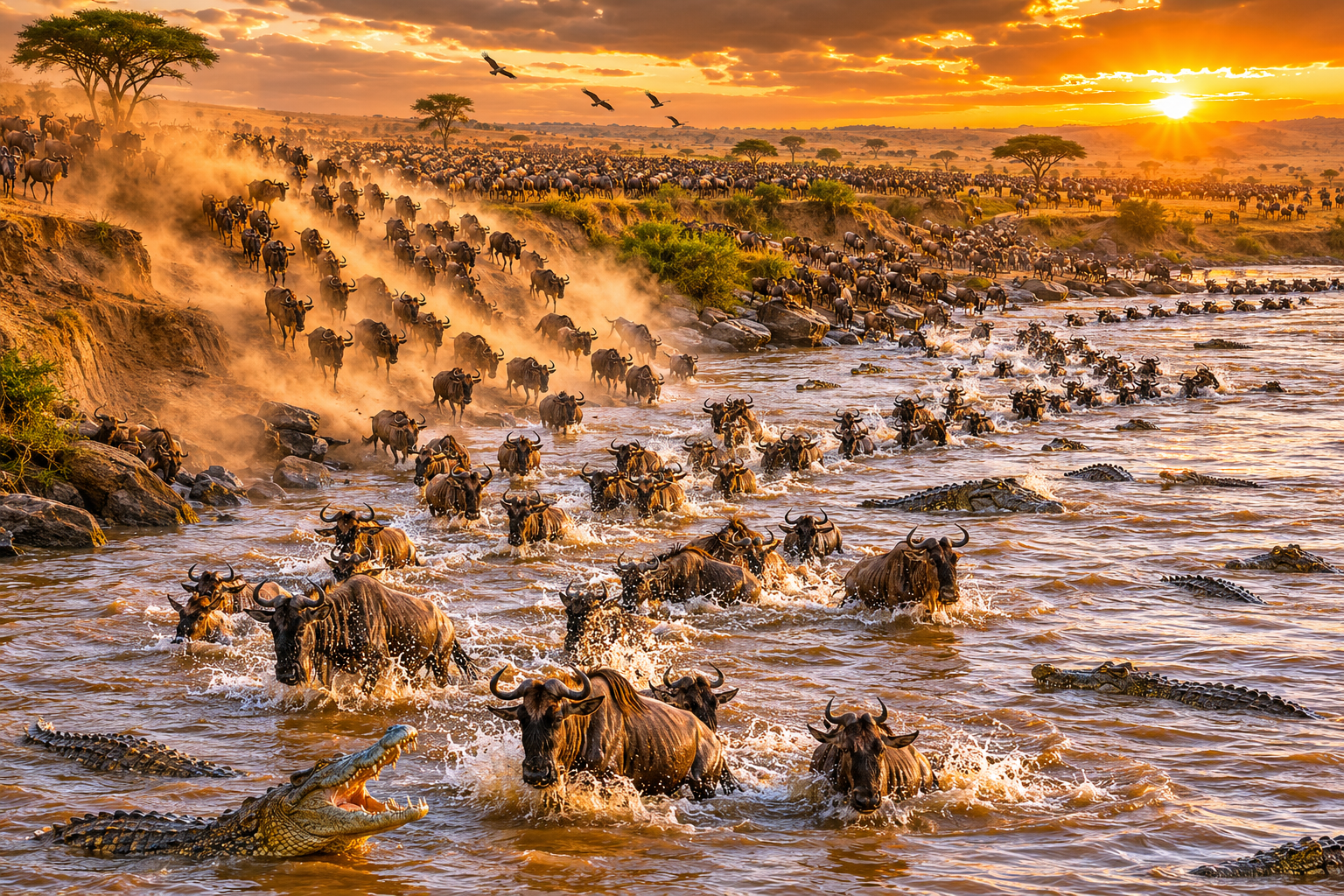
A week on the mountain pairs naturally with a Serengeti safari, timed if possible around the Great Migration, followed by several days of complete recovery on a Zanzibar beach. The contrast — the brutal cold of summit night followed a week later by warm Indian Ocean water — is, by every account, one of travel's more perfect sequences.
Read our complete Zanzibar Travel Guide →
What It Feels Like to Watch the Great Migration →
Is It Worth It?
Every person who has stood on Uhuru Peak at sunrise, after a night that tested them more than almost anything else in their life, answers this question the same way.
Yes.
Not because the summit itself is comfortable — it isn't, at -20°C with legs that have carried you through six days and a sleepless night. But because Kilimanjaro asks something specific of you: patience over speed, humility over ego, the discipline to walk slower than you want to for six straight days because that discipline is precisely what gets you to the top.
Most people who fail on this mountain don't fail because they weren't fit enough. They fail because they didn't respect pole pole.
Respect it, choose a proper route with proper acclimatization time, and the summit is genuinely within reach of most reasonably fit, reasonably determined people — no technical climbing background required.
Combine your Kilimanjaro climb with more of East Africa's extraordinary landscapes:
Explore more East Africa travel guides at vumbiventures.com/blog