
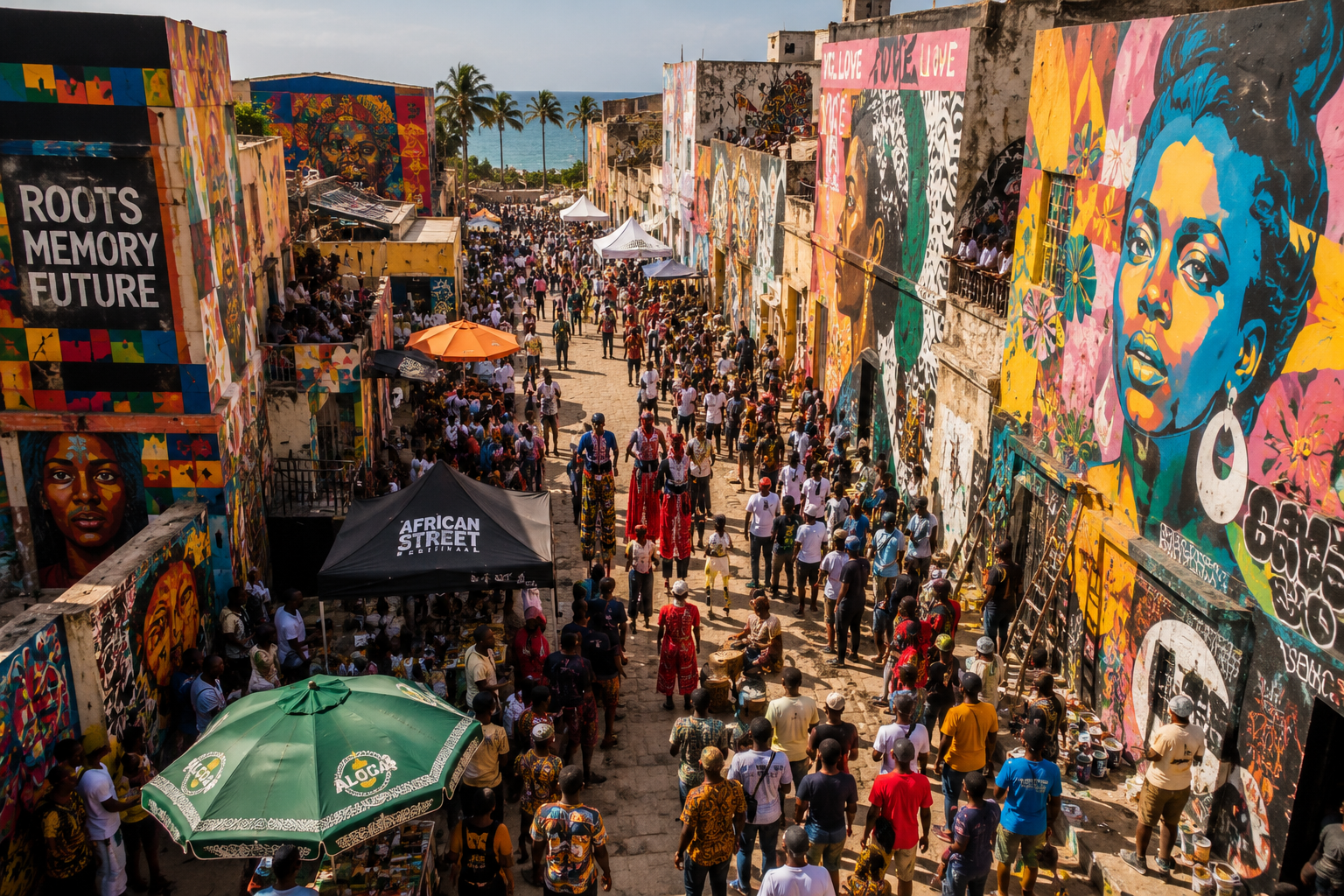
Every August, the streets of Jamestown in Accra, Ghana become something that has no real equivalent anywhere else in Africa. This is what happens when an entire neighbourhood decides that art belongs to everyone.
The name comes from the streets.
Not from a marketing agency. Not from a festival committee sitting in an air-conditioned room trying to find something authentic-sounding. It comes from the Ga language — the language of Accra's original inhabitants — where chale means friend or buddy, and wote means let's go.
Chale Wote. Friend, let's go.
It is also, importantly, the local name for the rubber flip-flops that every Ghanaian owns — the cheap, battered, beloved footwear of the streets. That the festival shares its name with a shoe worn by fishermen and market traders and schoolchildren is not an accident. It is a statement about who this festival belongs to.
Not to galleries. Not to collectors. Not to the kind of people who stand in white rooms sipping wine and nodding thoughtfully at paintings they don't understand.
To the streets. To Jamestown. To everyone.
The Neighbourhood That Became the Gallery
To understand Chale Wote, you first need to understand Jamestown.
It is one of Accra's oldest neighbourhoods — a fishing community built on the Atlantic coast of Ghana's capital, where the colonial-era James Fort and Ussher Fort still stand as reminders of the district's history as a centre of the transatlantic slave trade. The harbour still works. Fishermen still launch their brightly painted wooden boats into the Atlantic every morning, still return in the evenings, still spread their nets across the same beaches their great-grandparents used.
Jamestown is not wealthy. It is not gentrified. It has not been smoothed and polished for tourist consumption. Its streets are narrow and alive and occasionally chaotic, its buildings a mix of colonial architecture and improvised additions, its walls weathered by decades of Atlantic salt air.
For one week every August, those walls become some of the most extraordinary public art in Africa.
How It Started — and Why It Matters
In 2011, an Accra-based arts collective called ACCRA [dot] ALT had an idea.
They wanted to create an alternative arts platform — something that would take creative expression off gallery walls and out into the streets where anyone could encounter it. Something free. Something community-driven. Something that would prove that world-class art could emerge from one of Accra's most overlooked neighbourhoods.
The founders — Mantse Aryeequaye and Sionne Neely among the core organizers — were inspired by street art festivals happening in other parts of the world, but they wanted something distinctly Ghanaian. Something that wouldn't just import a Western cultural format but would use it to amplify African voices, African aesthetics, and African stories.
They called it Chale Wote. They held it in Jamestown. And then something happened that nobody fully predicted.
It worked.
Not just worked — it exploded. Within a few years, Chale Wote had grown from a small community gathering into one of the largest and most internationally recognized art events in West Africa, drawing artists, performers, musicians, and visitors from across Africa, Europe, and the Americas. Ghanaian artists who got their break at Chale Wote — Ibrahim Mahama, Serge Attukwei Clottey — went on to international careers and global recognition.
Fifteen years later, Jamestown's walls are permanently covered in murals that have become landmarks. The festival has given them a new identity — not erasing the neighbourhood's complex history but layering something extraordinary on top of it.
What Actually Happens at Chale Wote
Here is where most descriptions of Chale Wote fail. They list the categories — murals, performance art, music, spoken word — and leave you with an accurate but entirely inadequate picture of what it actually feels like to be there.
Let me try harder than that.
You arrive in Jamestown on a Saturday morning — the busiest day of the festival. The streets are already full by nine. Not full in the way that a crowded shopping centre is full — full in the way that a living thing is full, with movement and colour and sound coming from every direction simultaneously.
A wall that was bare yesterday has an eight-metre mural painted on it overnight — two artists on scaffolding are still adding detail to the upper right corner while a crowd has already gathered below, phones raised, arguing about what it means. It means several things. That's the point.
Thirty metres away, a performer in a costume made entirely of recycled plastic bags is moving through the crowd in slow motion, stopping occasionally to hold a pose for so long that people begin photographing themselves next to her as if she were a statue. Then she moves again. The crowd laughs, startled, delighted.
Music is coming from three directions. None of it is the same. A spoken word poet is performing in Twi on a makeshift stage — the crowd around her is two people deep and completely rapt even though half of them don't speak Twi. The rhythm carries it.
The fishing boats are still out in the harbour behind all of this. The Atlantic is doing what the Atlantic does, indifferent and immense.
You buy grilled fish from a woman with a charcoal grill on the pavement, eat it standing up, get sauce on your shirt, don't care. A child runs past wearing a crown made of bottle caps. Two teenagers are breakdancing in a circle that has formed around them spontaneously. A man in his sixties is watching the mural artists from a plastic chair he has brought from his house, nodding slowly.
This is what Chale Wote feels like. Not a festival you attend. A neighbourhood you fall into.
The Art — What to Look For
The murals are the most permanent element of Chale Wote. Every year new walls are painted, and unlike most festival art that disappears when the event ends, Chale Wote's murals stay. Jamestown has accumulated over a decade of them — an outdoor gallery that grows every August.
The work ranges from hyperrealistic portraiture to abstract political commentary to traditional Ghanaian motifs rendered in contemporary styles. The Nima Muhinmanchi Art collective has been behind many of the most striking pieces, working alongside local Jamestown artists who know every crack in every wall.
Walk slowly. Look up. Look for the ones that have been painted over previous murals — layers of years visible where the paint has chipped.
Performance art at Chale Wote is deliberately boundary-dissolving. You will not always know where the performance ends and the street begins. That is intentional. Some performances last five minutes. Some run for days. Some involve the audience in ways you don't realize until you're already part of it.
The music ranges across everything — highlife, Afrobeats, experimental electronic, traditional drumming, hip-hop in three languages. There is no single stage. Sound systems appear on corners, in courtyards, in the back of pickup trucks.
Fashion is both exhibited and worn. Some of the most extraordinary outfits you will see at Chale Wote are on people who are simply attending — treating the festival as a runway, an expression, a statement. Ghana has always understood that how you dress is a form of art.
Spoken word and poetry performances — often in English, Twi, Ga, or some fluid combination of all three — happen throughout the week. They are among the most emotionally direct things you will encounter at the festival.
Workshops run throughout the week, many of them open to anyone who shows up — recycled art making, photography, printmaking, drumming.
Film screenings happen in the evenings. Independent African cinema, screened outdoors, in a neighbourhood that has been making stories for a very long time.
The History Underneath the Festival
Jamestown carries weight that Chale Wote doesn't ignore.
The James Fort and Ussher Fort — both visible from the festival grounds — were built by European colonizers and used as holding facilities for enslaved Africans before they were transported across the Atlantic. Walking past them during Chale Wote, surrounded by art and music and the sounds of a neighbourhood very much alive, is a specific kind of feeling that is difficult to describe precisely.
The festival has never pretended this history doesn't exist. Some of the most powerful art at Chale Wote engages directly with it — with colonialism, with the slave trade, with what was taken and what remained and what was rebuilt. The theme changes every year, chosen by the organizing collective, and it invariably reflects something that Ghana and Africa are grappling with at that moment.
This is what separates Chale Wote from a street art festival in the European or American tradition. It is not decorative. It is not designed to make a neighbourhood look prettier for property developers. It emerges from a specific place with a specific history and it knows exactly where it is standing.
Practical Guide — How to Experience Chale Wote
When is it?
Chale Wote happens every August, typically in the third or fourth week. The exact dates are announced by ACCRA [dot] ALT usually around June. The festival runs for a full week, with Friday through Sunday being the most active days. Saturday is the day you cannot miss.
Getting to Accra:
Kotoka International Airport (ACC) in Accra receives direct flights from London, Amsterdam, Frankfurt, Dubai, New York, Washington DC, and multiple African hubs. From East Africa, fly via Nairobi or Addis Ababa. Ethiopian Airlines and Kenya Airways both operate this route.
Search and compare flights to Accra, Ghana →
Getting to Jamestown:
Jamestown is in central Accra, easily accessible from anywhere in the city. Uber and Bolt both operate in Accra and are reliable. Trotros (shared minibuses) run throughout the city for a few cedis if you want to travel like a local. The streets around Jamestown get very congested during peak festival hours — arrive early or be prepared to walk the last stretch.
Where to stay in Accra:
Stay in the Osu, Labone, or Airport Residential Area neighbourhoods for the best combination of safety, amenities, and Accra atmosphere. Jamestown itself has very limited tourist accommodation.
Search and compare hotels in Accra →
Cost:
The festival itself is completely free. Bring cash in Ghanaian Cedis for food, drinks, and purchasing art from vendors. ATMs are available in central Accra but less reliable in Jamestown itself — withdraw before you go.
What to wear:
Comfortable walking shoes — the streets are uneven and you will cover a lot of ground. Light, breathable clothing — August in Accra is hot and humid. If you want to dress for the occasion, dress boldly. Chale Wote rewards self-expression.
What to bring:
Water bottle, sunscreen, a camera or phone with good storage. Cash. An open mind. Leave behind any instinct to stand back and observe from a distance — Chale Wote is not a spectator sport.
Safety:
Accra is one of West Africa's safest capitals. Standard precautions apply during the festival — keep valuables secured, stay aware in large crowds, and keep your phone in a front pocket rather than displayed openly. The local community is actively involved in making the festival welcoming and safe.
If you want to exhibit or perform:
Applications for artists and performers open in June — two months before the event. Follow ACCRA [dot] ALT on social media for announcements. The festival actively seeks both Ghanaian and international artists.
Why This Festival Belongs on Your Africa Bucket List
There are African festivals that are famous because they are ancient. There are African festivals famous because they are large. And there are African festivals famous because they are beautiful.
Chale Wote is famous because it is necessary.
It exists because someone looked at a fishing neighbourhood in Accra — a place with a painful history and insufficient resources and extraordinary human energy — and decided that the answer to all of it was art. Free art. Public art. Art that belongs to the street and to everyone who walks down it.
That impulse — to make something beautiful and give it away in a place that needs beauty — is one of the most African things I know. Not African in a romantic, oversimplified way. African in the specific, stubborn, community-rooted way that builds things that last.
Chale Wote started with nothing. It built itself into one of the most important cultural events in West Africa in fifteen years. It did it in Jamestown. It did it for free. It did it by believing that world-class art doesn't require a world-class institution.
It just requires a wall, a friend, and somewhere to go.
Chale wote.
Chale Wote is just one of Africa's extraordinary cultural experiences. Explore more: Unforgettable African Festivals You Need to Experience

