
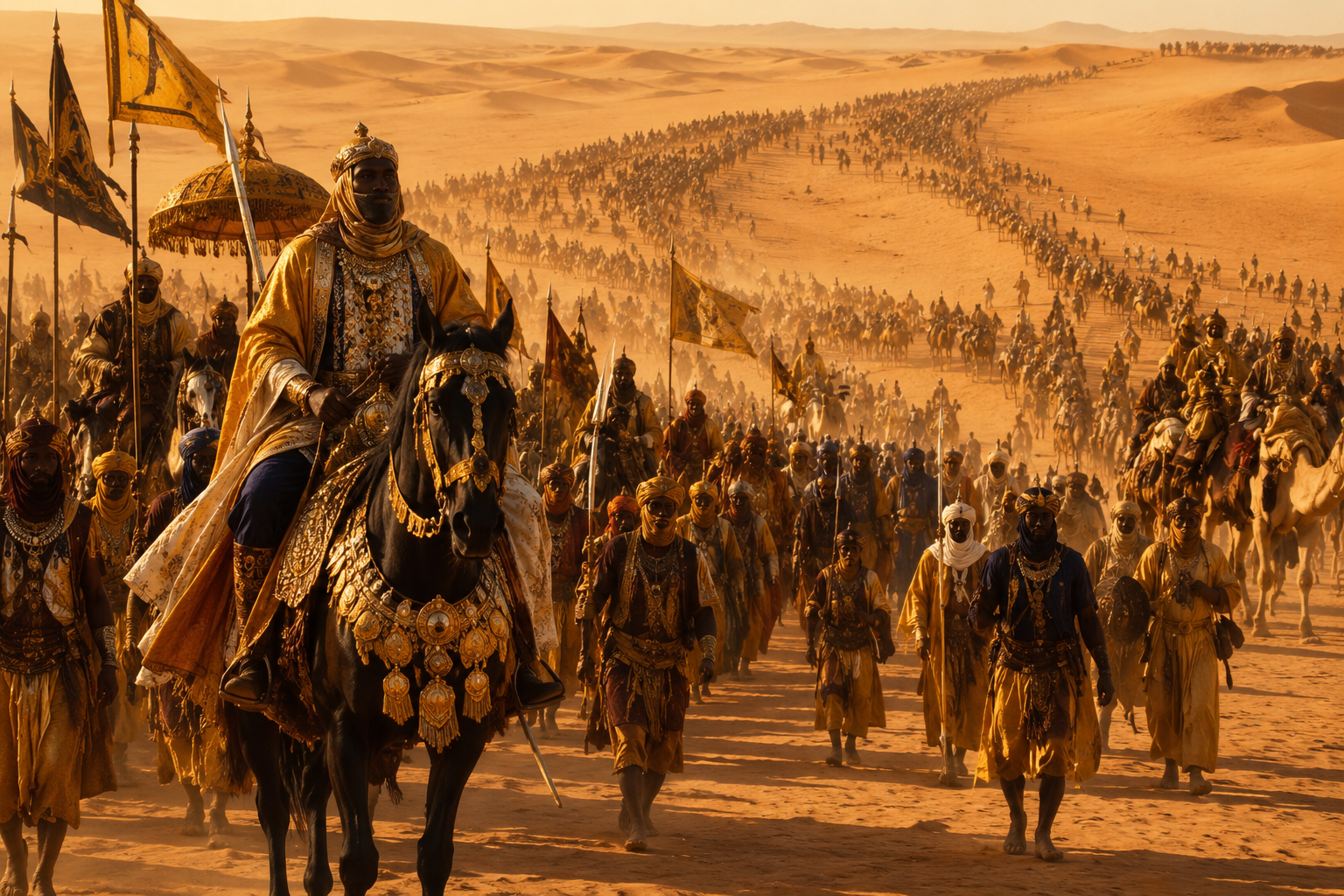
In 1324, the Emperor of Mali set out on a pilgrimage to Mecca. He brought so much gold with him that he single-handedly destroyed Egypt's economy — and didn't find out until he was on his way home.
There is a number that historians keep returning to when they try to explain Mansa Musa's wealth.
$400 billion.
That's the modern estimate — adjusted for inflation — of what Mansa Musa was worth at the height of his power. For context, Elon Musk, currently the wealthiest living person on earth, is worth roughly $200 billion. Jeff Bezos built Amazon from a garage and accumulated around $170 billion. John D. Rockefeller, whose Standard Oil monopoly controlled 90% of American oil production, had an estimated net worth of $340 billion in today's terms.
Mansa Musa had more than all of them.
And yet until recently — until the internet began recovering the stories that colonial education systems deliberately buried — most people had never heard of him.
This is the story of the richest person in all of recorded human history. An African emperor. A builder of universities. A man so wealthy that a single act of generosity on a religious pilgrimage crashed the economy of an entire country for twelve years.
His name was Mansa Musa. And the world has been slowly catching up to him ever since.
The Empire That Made Him
To understand Mansa Musa, you first need to understand what he was sitting on top of.
The Mali Empire in the 14th century was not a small kingdom. At its height under Musa's reign, it stretched across eight modern nations — Mali, Senegal, Gambia, Guinea, Guinea-Bissau, Niger, Nigeria, and Mauritania — covering roughly 1.29 million square kilometres of West Africa. It was one of the largest empires on earth at the time, comparable in scale to the Mongol Empire that had terrorized Eurasia just decades earlier.
But unlike the Mongols, whose power came from conquest and terror, Mali's power came from something far more durable: geography and trade.
The empire sat at the crossroads of the most important trans-Saharan trade routes in the medieval world. Caravans crossing the Sahara from North Africa — carrying salt, cloth, horses, and luxury goods — had no choice but to pass through Mali's territory. And what Mali sent back north in exchange was the commodity the medieval world ran on.
Gold.
The Bambuk and Bure goldfields in Mali's territory were among the most productive in the known world. At the height of the empire, historians estimate Mali supplied between half and two-thirds of the world's entire gold production. The Niger River valley was rich in agricultural land. The empire controlled salt mines at Taghaza whose product was literally worth its weight in gold in the markets of Sub-Saharan Africa.
Mali didn't just have wealth. Mali was the engine of the medieval world's economy.
And Mansa Musa sat at the centre of it all.
How He Came to the Throne
The story of how Musa became emperor is itself connected to one of African history's greatest mysteries.
His predecessor was Abubakari II — an emperor consumed by curiosity about what lay beyond the Atlantic Ocean. In 1311, Abubakari made the extraordinary decision to abdicate the most powerful throne in Africa and personally lead an expedition of 2,000 ships westward into the Atlantic. He was never seen again.
(Read the full story of Abubakari II's Atlantic voyage here Part I and Part II)
With Abubakari gone, the throne passed to Musa — described in contemporary accounts as Abubakari's brother, deputy, or close relative depending on the source. The exact relationship remains debated by historians, but what is agreed upon is this: Musa was the man left holding the empire when its previous ruler sailed into the unknown.
He would prove to be one of the most capable rulers in African history.
Building an Empire at Its Peak
Mansa Musa ruled for 25 years — from approximately 1312 to 1337. In that time he transformed the Mali Empire from already wealthy to something approaching incomprehensible.
Territorial expansion. Under Musa, the empire grew to its greatest extent. He conquered the city of Gao to the east, extending Mali's reach across the entire sweep of West Africa. His army numbered in the tens of thousands and was among the most formidable military forces on the continent.
Trade dominance. Musa tightened Mali's grip on the trans-Saharan trade routes. Gold, salt, ivory, and kola nuts flowed through his territory. Taxes on trade filled the imperial treasury with a regularity that would have made European monarchs weep with envy.
Religious investment. Musa was a devout Muslim who saw his faith not as a private matter but as an organizing principle for his empire. He built mosques, funded Islamic scholars, and positioned Mali as a centre of Muslim learning in sub-Saharan Africa. Islamic archaeologist Timothy Insoll has described his reign as having transformed Mali into what he called a "true Muslim empire."
Timbuktu. Perhaps Musa's most enduring legacy was his investment in the city of Timbuktu and its famous University of Sankore. Under his patronage, Timbuktu became one of the great intellectual centres of the medieval world — a city of 25,000 students, 150 schools, and a library system that housed up to one million manuscripts.
The full story of what was built in Timbuktu — and the 2012 crisis that nearly destroyed it — is here: The Lost Libraries of Timbuktu
This was the empire, the city, and the legacy that Mansa Musa was building. And then in 1324 he decided to go on a pilgrimage.
Nothing would ever be quite the same again.
The Pilgrimage That Changed History
Every Muslim who is physically and financially able is required to complete the Hajj — a pilgrimage to the holy city of Mecca in modern Saudi Arabia — at least once in their lifetime. For Mansa Musa, completing the Hajj was both a religious obligation and a political statement.
He would go to Mecca. And he would go in a way that made absolutely sure the world knew who he was.
The caravan that assembled outside Mali's capital of Niani in 1324 was unlike anything the medieval world had ever seen.
60,000 people accompanied the emperor on his journey — soldiers, officials, scholars, attendants, servants, and enslaved people. Among them were 500 heralds who walked ahead of the procession, each one dressed in Persian silk and carrying a golden staff weighing approximately 2.1 kilograms. Behind them came 100 camels, each carrying between 100 and 136 kilograms of pure gold dust.
The historian Michael A. Gomez, in his acclaimed book African Dominion, calculated the total gold Musa brought on the journey at the equivalent of 16 metric tons. To put that in perspective: all the gold ever mined throughout human history amounts to approximately 200,000 metric tons — and more than half of that has been mined since the 1950s. Musa was carrying 16 metric tons of it on a single religious trip.
The journey from Mali to Mecca covered at least 6,000 miles overland — through the Sahara, along the North African coast, through Egypt, and down through the Arabian Peninsula. It took months. And everywhere the caravan stopped, Musa gave gold away.
To mosques. To scholars. To the poor. To local rulers. To anyone who needed it.
He was, by every account, genuinely generous. Not performatively generous — genuinely generous. A man who believed that wealth was a responsibility to be distributed, not a trophy to be hoarded.
And that genuine generosity was about to cause an economic catastrophe.
The Man Who Crashed Egypt's Economy by Being Too Generous
When Mansa Musa's caravan arrived in Cairo in July 1324, the Egyptian Sultan Al-Nasir Muhammad sent his senior official, Emir Abu al-Abbas, to greet the visiting emperor with full honours.
The account of what happened next comes directly from Al-Umari, the Arab historian from Damascus who interviewed eyewitnesses in Cairo thirteen years later. His account remains one of the most vivid primary source descriptions of Mansa Musa in existence.
According to Al-Umari, Musa refused the Sultan's invitation to visit the Citadel — the seat of Egyptian power — saying through an interpreter that he had come only for the Pilgrimage and did not wish to mix it with anything else. This detail — that Musa spoke perfect Arabic but chose to speak through an interpreter, to maintain the dignity and formality of an emperor addressing an equal — is one of those small historical details that reveals an enormous amount about the man.
He was not intimidated by Egypt. He was not a supplicant. He was a sovereign on a spiritual journey, and he would conduct himself accordingly.
But then he started spending.
Musa distributed gold throughout Cairo with a liberality that stunned the city. He gave to mosques, to scholars, to merchants, to the poor. His entourage shopped in Cairo's markets and paid prices that no sensible merchant could refuse. Gold flowed through the city's economy like water through sand.
The Cairenes, according to Al-Umari, were initially delighted. Free gold. Rising prices. A booming market. What was there to complain about?
The answer became clear over the following months.
By flooding Cairo with gold, Mansa Musa had destroyed its value.
Gold was currency. When the supply of gold in an economy suddenly increases dramatically without a corresponding increase in goods and services, the value of gold falls and the prices of everything else rise. In modern economic terms, Musa had caused hyperinflation through an uncontrolled expansion of the money supply.
The value of gold in Cairo dropped by an estimated 25% almost immediately. Prices for goods rocketed. Merchants who had accepted gold at pre-Musa rates found themselves holding currency worth a quarter less than it had been days before. The Egyptian economy, which depended on gold as its primary medium of exchange, went into a recession that historians estimate lasted twelve years.
Twelve years. From a man passing through.
When Musa heard about the damage on his return journey from Mecca, he did something remarkable. He attempted to fix it — by borrowing gold back from Egyptian merchants at interest, deliberately removing gold from circulation to restore its value. It was, by any measure, one of the earliest recorded attempts at deliberate monetary policy in history. An African emperor, in 1324, attempting to conduct quantitative tightening on a foreign economy he had accidentally destabilised.
The Egyptian economy recovered. Eventually. But Al-Umari, writing thirteen years later, noted that Cairenes were still talking about Mansa Musa's visit with a mixture of awe and lingering economic trauma.
What He Built When He Came Home
Musa returned from Mecca a changed man — or rather, a man with a clearer vision of what he wanted his empire to become.
He brought back with him some of the finest architects and scholars from the Islamic world. Among them was Abu Ishaq al-Sahili, a poet and architect from Granada in Andalusia, whom Musa had met in Mecca and persuaded to return to Mali. Al-Sahili would go on to design some of the most significant structures in West African architectural history.
The Djinguereber Mosque in Timbuktu — still standing today, still active, still one of the most important mosques in West Africa — was built under Musa's patronage using Al-Sahili's designs. Its distinctive earthen architecture, with its wooden beams protruding from the walls (used for replastering during annual maintenance), became the defining visual style of Sahelian architecture.
The Sankore Mosque and University — already established before Musa's reign, but transformed under his patronage into one of the greatest institutions of learning in the medieval world. At its peak, the University of Sankore had a larger student population than the University of Oxford at the same period. Its scholars produced hundreds of thousands of manuscripts on theology, law, astronomy, medicine, history, and mathematics — many of which survive to this day.
Musa's investment in Timbuktu was not vanity spending. It was a deliberate act of civilizational building — a calculated effort to make his empire a centre of knowledge, culture, and religious authority that would attract scholars, traders, and pilgrims from across the known world.
It worked. By the time of Musa's death, Timbuktu was one of the most important cities on earth.
The Map That Put Africa on Europe's Radar
One of the most extraordinary consequences of Mansa Musa's 1324 pilgrimage was what happened in Europe.
Word of his caravan — the gold, the silk, the 60,000 attendants, the economic devastation left in his wake — spread through the Islamic world and eventually reached European ears. Spanish and Italian merchants in North Africa heard the stories. Geographers began asking questions.
In 1375, the Catalan Atlas — one of the most sophisticated and detailed maps of the medieval world, created by the Majorcan cartographer Abraham Cresques — included a depiction of Mansa Musa sitting on his throne in West Africa, holding a large gold nugget, with the caption describing him as the richest and most noble king in all the land.
This was Europe's introduction to sub-Saharan Africa as a place of civilization, wealth, and power rather than a blank space on the map.
It was also, in a tragic irony, the beginning of European interest in Africa's resources — an interest that would eventually fuel the transatlantic slave trade and the colonial projects of the 15th, 16th, and 17th centuries.
Mansa Musa's pilgrimage announced Africa to the world. And the world, eventually, came — though not in the way he would have wished.
The Question of His Wealth — And Why It's Hard to Calculate
Historians and economists have repeatedly tried to calculate exactly how wealthy Mansa Musa was, and the numbers vary wildly depending on methodology.
The $400 billion figure — cited by Celebrity Net Worth and repeated widely — is probably too precise to be taken literally. The honest answer is that Musa's wealth is essentially incalculable in modern terms for several reasons:
Gold was currency. Musa didn't just have gold — he controlled the production and supply of gold for much of the known world. That's not comparable to having a bank balance. It's closer to owning the central bank.
His wealth was an empire. His $400 billion is an attempt to value not just his personal holdings but the entire productive capacity of an empire of millions of people. By that logic, every emperor in history was a billionaire.
The sources are estimates. Al-Umari, Ibn Battuta, and Ibn Khaldun all wrote about Musa's wealth in terms of superlatives — the richest, the most powerful, the most generous. None of them were economic auditors. Their accounts are vivid and credible but not precise.
What we can say with confidence is this: no other individual in recorded history has been identified as controlling a larger share of the world's total wealth at the time of their peak power. Whether that translates to $400 billion or $200 billion or an unquantifiable sum, the conclusion is the same.
He was, by any reasonable measure, the wealthiest person who ever lived.
The Legacy He Left Behind
Mansa Musa died sometime between 1332 and 1337 — the historical sources disagree on the exact date. He had reportedly planned to abdicate his throne and return to Mecca to spend his final years in prayer, but died before he could do so.
The empire he left behind was at its absolute peak — territorially vast, intellectually vibrant, economically dominant. His son and successor, Mansa Maghan, inherited the greatest prize in the world.
And then began to lose it.
Within decades of Musa's death, the Mali Empire began its long slow decline. Succession disputes, external pressure from the rising Songhai Empire to the east, and the gradual disruption of trans-Saharan trade routes by Portuguese coastal shipping all took their toll. By the mid-15th century, Mali had lost control of Timbuktu and Gao. By the 17th century, the empire had effectively ceased to exist.
But what Musa built in those 25 years — the mosques, the universities, the manuscripts, the trade networks, the scholarly tradition — outlasted the empire itself.
The Djinguereber Mosque still stands in Timbuktu. The manuscripts — or at least 350,000 of them, rescued from armed occupation in 2012 — still exist. The intellectual tradition of the University of Sankore still echoes through West African scholarship.
And the name Mansa Musa — once buried under centuries of colonial miseducation — is being reclaimed by millions of people across the African diaspora as evidence of what the continent built before the world came to take it apart.
Why This Story Was Hidden From You
Here is the uncomfortable question that sits at the centre of Mansa Musa's story:
Why didn't you learn about him in school?
The honest answer is not complicated. The colonial education systems imposed on Africa and taught to the diaspora were designed — explicitly and deliberately — to produce a particular understanding of history: one in which civilization flowed from Europe outward, in which Africa was a passive recipient of progress rather than an originator of it, in which the story of the world began in Greece and Rome and ended in London and Paris.
Mansa Musa doesn't fit that story. An African emperor richer than any European king. A city in Mali more intellectually vibrant than anything in 14th-century Europe. A university older than Oxford producing scholarship that influenced Islamic science and law across the known world.
These facts were not unknown to European historians. They were documented in the Arabic sources that European scholars had access to for centuries. The Catalan Atlas had Mansa Musa's face on it in 1375.
The choice to exclude him from standard historical education was not an oversight. It was a decision.
The good news is that the internet — and the generation that grew up with it — is undoing that decision one article at a time.
Mansa Musa is coming back. And with him, the full story of what Africa built.
Mansa Musa inherited the throne from his predecessor Abubakari II — the emperor who gave up everything to sail the Atlantic. Read that story:
The university Mansa Musa built in Timbuktu nearly lost its million manuscripts in 2012. Read the full rescue story: The Lost Libraries of Timbuktu
Explore more untold African history at Vumbi Ventures - Field Notes


